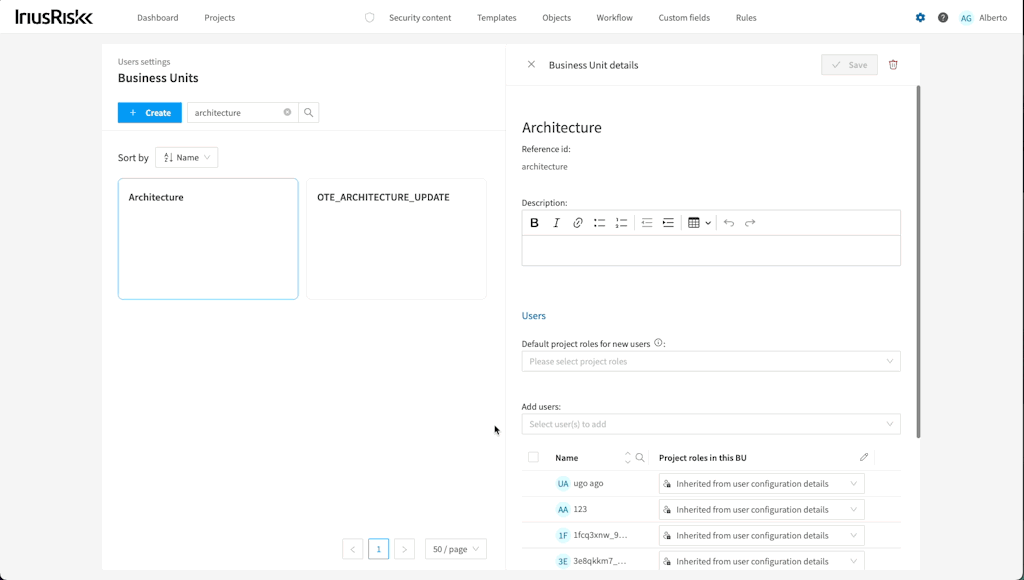
Administrators can now assign roles at the user level within a BU or to users who do not belong to any BU, ensuring maximum flexibility and precise control over access and permissions.
Key benefits include:
Granularity in Role Assignments: Assign specific project roles to individual users within a Business Unit (BU), rather than applying roles uniformly at the BU level. Example: A BU-specific user can be directly assigned Developer or Admin roles within the same BU.
Centralized Role Management: Manage project roles directly from the BU section, eliminating the need to navigate through the Project Access modal. Example: Administrators can now configure roles for Alice and Bob directly within the Phase 3 BU, instead of using separate interfaces.
Enhanced Visibility in User Profiles: Users can now see the different BUs they belong to and the specific Project Roles assigned to them within each BU in their User Profile section. Example: A user profile displays membership in "Cloud Team" with the role of Viewer and "Development Team" with the role of Developer.
Once a Business Unit is defined, Admin’s can now use ‘Default User Role Assignment’ to configure default roles for users within a Business Unit. These roles are automatically applied to new users added to that Business Unit, which is helpful for time saving and consistency.
Need to see a user’s default role?
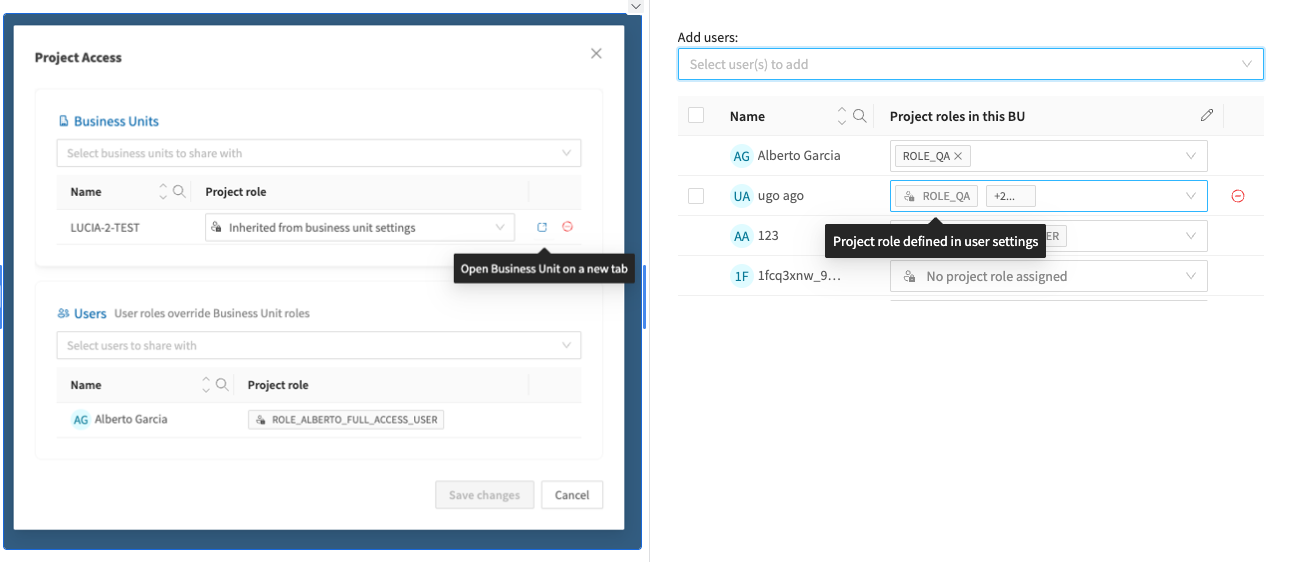
We’ve updated the Project Access modal and Business Unit pages to make project role sources clearer. Users gain greater visibility and understanding of how project roles are assigned and inherited across both the Project Access modal and Business Unit pages.
In the Project Access modal, you can still view which users and business units have access to a project.
For users, it’s now clear which roles are inherited and where they are defined.
For business units, a new quick link takes you directly to the BU page to view or manage user roles.
On the Business Unit page, you can now easily see which roles each user inherits from their profile.
The updated layout and terminology make the relationships between users, business units, and roles transparent and easy to interpret at a glance.